

What does it look like when we apply the command to love our neighbor as ourselves to a spouse? We are only human, but sometimes people treat spouses like they are supposed to fulfill them in a way that only God can. Love will not hold people to impossible standards.
Continue readingTag Archives: marriage
Were Adam and Eve Married?
I’ve seen some arguments online against abstinence, saying that since Adam and Eve didn’t have a wedding, they were fornicating. The Bible defines marriage as being between a man and a woman, but it doesn’t provide directives on weddings. Every culture around the world has unique wedding traditions, and God recognizes all of those marriages, even if they have different religions, as long as they follow the model of Genesis 1:27 and 2:24 (which is reiterated by Jesus in Matt 19:1-6).
Continue readingMarriage Definition
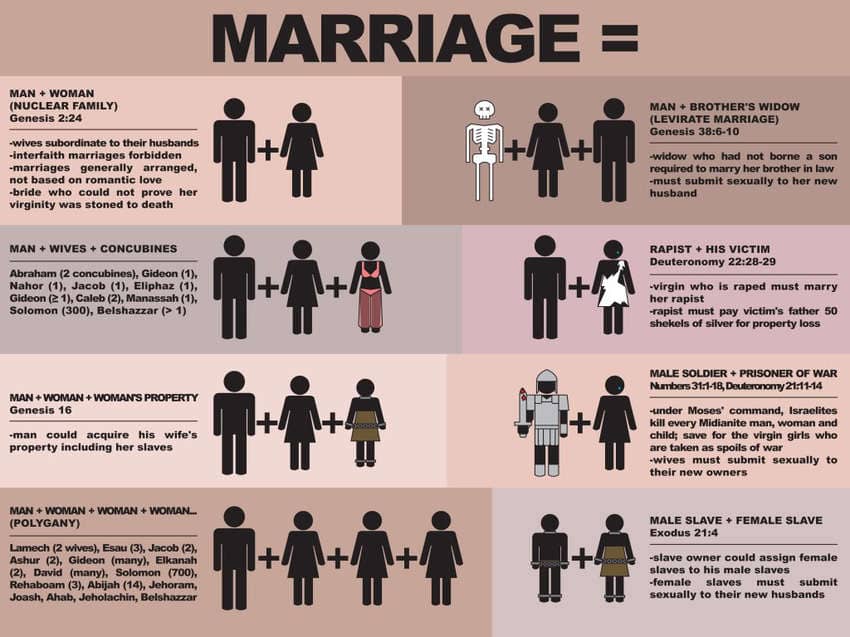
This essay was written in response to this meme that is often used to critique the biblical definition of marriage.

Is a Soulmate Biblical?
Is the concept of soulmates truly biblical? It’s valid to a certain extent, but not universally applicable to everyone in the same way.
Continue readingThe Greatest Marriage Proposal
Why does God give us a choice in the first place? Doesn’t he want absolute obedience? If he wished for absolute obedience, then he would have made us robots, pre-programmed to say ‘I love you’. The Bible often compares God’s covenant relationship to human ones, such as a parent to a child (Creator to creation) and a husband to a wife (God to His people). Most people can understand the view of God as a Father, but seeing God as a husband seems strange to some. What is the difference between the two kinds of relationships?
Continue reading1st Century Roman Marriage Law
Let’s examine the historical and cultural context of marriage in Rome during the first century to gain a better understanding of the New Testament. In Roman law of the 1st century, it was illegal for a man or woman not to be married between the ages of 25 and 60 (for men) and 20 and 50 (for women). So, for the Romans, celibacy was a crime, and there were restrictions on those who were celibate; this is one of the many issues that put Christians at odds with the Roman Empire. Especially Paul, because he was celibate and encouraged (but did not require) celibacy in 1 Corinthians 7.
Continue reading