

An overview of what the Gospel of Jesus Christ is. The Gospel is good news about how God wants to save us from our destruction, yet over the years, humans have twisted the Gospel to the point that they have threatened people with it. Good news can never be a threat. This article is written the purpose of explaining what the gospel is, why it is good news, and why it is needed.
Continue readingCategory Archives: Theology
Different Topics concerning Theology like Spirituality, Ecclesia (The Church), Eschatalolgy (End of Days), Soteriology (Salvation), and Super Natural Beings
The Faith of Elijah and the Widow
1 Kings chapter 17 illustrates aspects of God’s character and His promise of provision, as well as our role in receiving from Him. It is the story of the prophet Elijah and a widow in Zarephath.
Continue readingConfession: Uprooting vs Burying Sin
Pretending that temptation doesn’t exist to avoid engaging with it makes it harder to resist, and it makes you miserable. However, calling it out directly and acknowledging it changes things. Confession can be a form of therapy.
Continue readingOnce Saved Always Saved?
Eternal life is promised to those who believe, but what happens if they stop believing? What about someone who believes but struggles with sin? Is there a difference?
Continue readingThe Context of Matthew 18
What is the context of the “binding and loosing” statement in Matt 16 and 18? Is it about a prayer of agreement, or is it about excommunication? If the latter, is there still evidence for a prayer of agreement?
Continue readingEt (Aleph Tau) in Genesis 1:1
Some people have suggested that there are seven words in the Hebrew version of Genesis 1:1, and the word “Et” is a special word that points to Jesus. “Et” is spelled with “את” (aleph and tau), the first and last letters of the Hebrew alphabet. They say this word is untranslated because the Jews forgot its meaning, and that it points to Jesus because it says He is the “Alpha and Omega” in Revelation 1:8, which references the first and last letters of the Greek alphabet. This gets connected to John 1:1, which says, “In the beginning was the Word [Jesus], and the Word was with God, and the Word was God.” It sounds romantic, but that’s not true and ignores the rules in the Hebrew language.
Continue readingGod’s Protection Promise
There is a lot of fear-mongering going around. How are Christians supposed to react to things that are out of their control? If the food supply is poisoned or if mass inflation is happening, can Christians count on God?
Continue readingA Deeper Look At Psalms 1 and 2
Psalms 1 and 2 are alluded to in Jesus’ teachings. Let’s look at what they are saying.
Continue readingWhat is Testing God?
What does it mean to test God? In Matt 4:5-7, when Satan is tempting Jesus, he tells Jesus to jump off the Temple and says that God should protect him. Then Satan quotes Psalms 91:11-12, which says, “It is written: ‘He will order his angels to protect you. And they will hold you up with their hands so you won’t even hurt your foot on a stone.’” Jesus responds in verse 7 by saying, “It is also written: ‘You must not test the Lord your God.”
Continue readingThe Context of Supernatural In The Bible Pt.1
This essay is part one of a two-part series responding to a meme. The meme in question suggests that since supernatural and ritualistic elements are in the Bible, magic and witchcraft can’t be sinful, and that the Bible is contradictory. Part 2–>

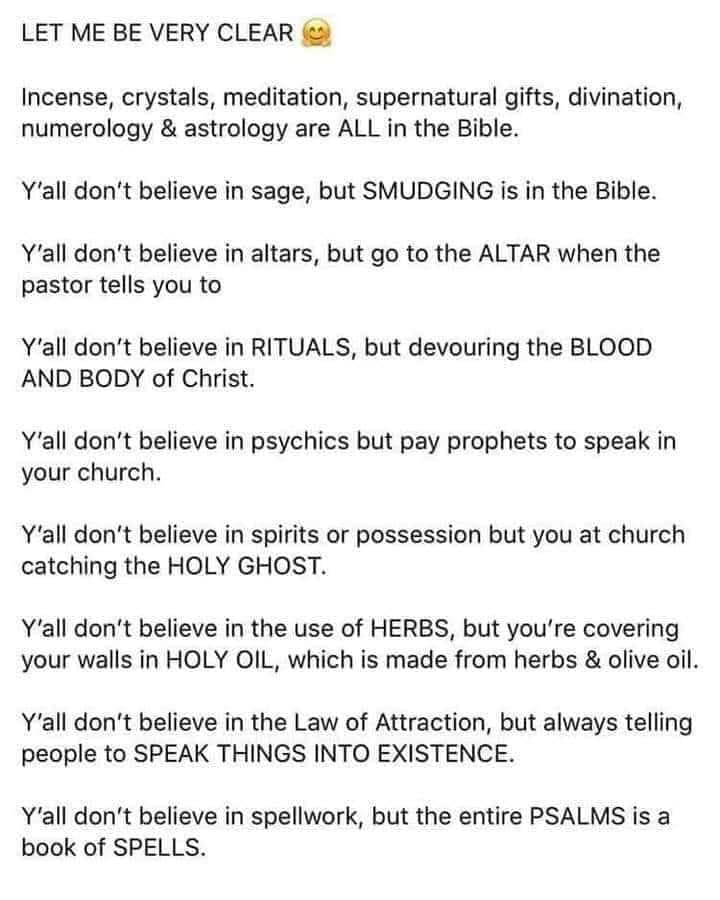
God was completely against people using gemstones as charms because it was deceptive. Deuteronomy 18:9-12 makes it clear that God was against fortune-telling, sorcery, looking for omens, witchcraft, casting spells, or functioning as mediums or psychics, calling forth the spirits of the dead. In Ezekiel 13:18-21, God curses those who use these things to deceive his people. Revelation 21:8 and 22:14-15 both have a list of sins that will prohibit people from inheriting the kingdom: sorcery, witchcraft, and such. Most of the other things listed are entirely out of context or the result of bad denominational theology.
Continue reading