
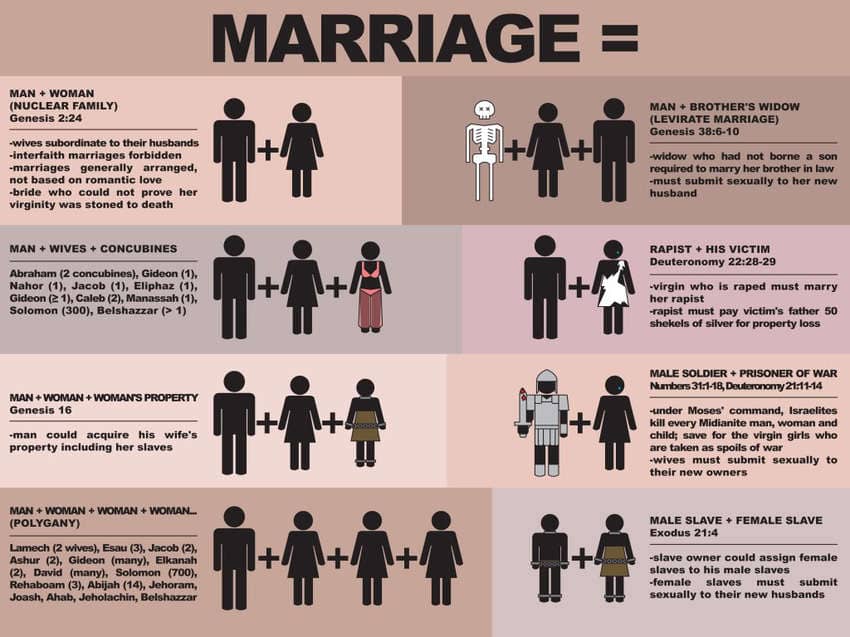
This essay was written in response to this meme that is often used to critique the biblical definition of marriage.


A biblical view of the cultural and somewhat political Issues of the day.
This essay was written in response to this meme that is often used to critique the biblical definition of marriage.
Often, when a bible believer is against contraception, they reference verses like 1 Tim 2:15 and Gen 38:9-Often, when a Bible believer is against contraception, they reference verses like 1 Tim 2:15 and Gen 38:9-10, but those verses are out of context. One talks about wives and their husbands, and the other is about a guy who hated his brother. The Bible doesn’t speak on contraception, thus no one can claim it a sin or not a sin.
Continue readingCan Christians practice polygamy, since it is in the Bible? While polygamy was allowed in the Bible in the Old Testament, with some restrictions, in the New Testament, men are told to have one wife (1 Tim 2:3), mimicking Christ’s relationship with the one church (body of Christ).
Continue readingAre all adulterers supposed to die in the Bible? When looking at Leviticus 20:10 and Deut 22:22, some people assume this means that ALL adultery is punishable by death. The story in John 8:1-11, about the woman caught in adultery being judged by Jesus, is usually what comes into the modern mind. However, there are alternatives to death based on the conditions in which the adultery is discovered.
Continue readingLet’s examine the historical and cultural context of marriage in Rome during the first century to gain a better understanding of the New Testament. In Roman law of the 1st century, it was illegal for a man or woman not to be married between the ages of 25 and 60 (for men) and 20 and 50 (for women). So, for the Romans, celibacy was a crime, and there were restrictions on those who were celibate; this is one of the many issues that put Christians at odds with the Roman Empire. Especially Paul, because he was celibate and encouraged (but did not require) celibacy in 1 Corinthians 7.
Continue readingIn the New Covenant, marriage is not an expectation, as we don’t make new kingdom members by having children, but rather by sharing the gospel. Jesus affirmed the option of being a eunuch in Matt 19:11-12 when talking about people made eunuchs (castrated by emperors), born eunuchs (asexual or possibly intersex), or made themselves eunuchs (either through castration or will-powered celibacy) for the Kingdom.
Continue readingSome people have used Deuteronomy 22:5 to suggest that women can’t wear pants, because it is considered “men’s clothing.” Is that correct? Are they men’s clothing? Also, can Deut 22:5 even be applied to non-Jews outside of Israel? Should Gentiles also put tassels on their clothing to remember the law, as Deut 22:12 says?
Continue readingShould Christian women cover their hair? It seems like that is what Paul is saying in 1 Corinthians 11:1-15, but cultural context reveals that there is more to this.
Continue reading1 Tim 2:11-15 and 1 Cor 14:34-35 are often cited as sexist verses in the bible that require women to be silent in church. However, proper examination of the original language and context of this letter reveals that it’s not like that. First of all, if women weren’t allowed to speak at all, then why does Paul instruct them on how to pray and prophesy in 1 Corinthians 11:5, both of which require speaking? Women who were prophets in the Bible can be found in Exodus 15:20, Judges 4:4-5, Luke 2:36, Acts 2:17, and Acts 21:9.
Continue readingThere are three interpretations of 1 Timothy 2:12-15 concerning the role of women in the church. Both letters to Timothy were written to help him deal with an uprising of false teachers in the Ephesian church. These false teachers are Hymenaeus, Alexander, and Philetus. These men were either influencing some rebellious women or being influenced by them.
Continue reading