

This essay is part one of a two-part series responding to a meme. The meme in question suggests that since supernatural and ritualistic elements are in the Bible, magic and witchcraft can’t be sinful, and that the Bible is contradictory. <– Part 1

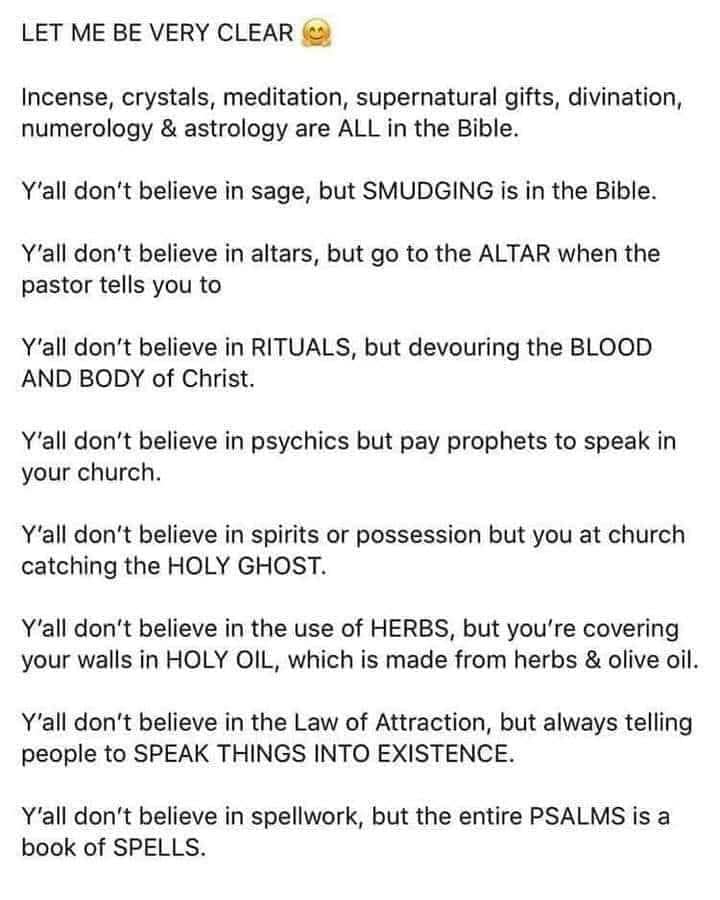
Altars:
The “altar” in a church building is not really an altar; it’s a pulpit or podium for speaking. Christians don’t need to burn sacrifices. Besides, just because altars are in the Bible doesn’t mean it condones building random altars to worship anything or anyone. Every altar that men of God like Noah (Gen 8:20), Abraham (Gen 12:7-8), Jacob (Gen 35:1-3), Moses (Ex 17:15), and Joshua (Josh 8:30) were built for sacrifices to YHWH God, or as memorials for something YHWH did. None of the altars God condoned were built to worship any other gods or spirits. God gave them specific instructions on how to set up natural altars in Ex 20:22-26 and Deut 27:5-6. Later, the Israelites built a bronze altar for sacrifices and a golden altar for incense for the Tabernacle or Temple (Ex 27:1-8, 1 Kings 6-8). God instructed the use of this unique bronze altar and to avoid worshiping Him in the same manner as the Canaanites worshipped their gods (Deut 12).
God ultimately exiled the Israelites because they defiled his altar and Temple with idolatry. You can read what they were doing in Ezekiel 8. They were expelled and punished for worshipping idols and even sacrificing their children to Molech (Lev 18:21 and 20:2-5, Jer 32:35). Furthermore, the Israelites were told to destroy the altars of the Canaanites when they entered the land to prevent them from copying the customs of the Canaanites and committing idolatry and child sacrifice. We can see God telling them to destroy Asherah poles and pagan altars in Ex 34:13, Deut 7:5, and Deut 12:3. God scolds them for not doing this in Judges 2:2, and various kings, starting with Solomon, sinned against God by allowing pagan altars and shrines in the land and this is what led to their downfall and exile (1 Kings 11:1-6).
The sacrifices of animals were a temporary measure done to cover human sins, and it was a part of a necessary process to keep the Israelites pure enough to be in God’s presence. This is because the cost of sin is death (Rom 6:23). The Israelites had to sacrifice over and over because animals can’t fully atone for humans. After all, humans are made in God’s image. However, human sacrifices wouldn’t have worked since no human was sinless. Animals are not what God wanted because he already owned all animals (Ps 50:14-15), and the sacrifice of animals wasn’t transforming the hearts of men and cleansing them of sin. The sacrifice of the Messiah (Jesus) was a sacrifice of Emmanuel (God with us) himself. Being a sinless human qualified him to die for our sins and allow us to get the Holy Spirit. Learn more about these things by reading Isa 53:4-11, Matt 8:17, Rom 5:12-17, and Heb 10:1-18. The Altar in heaven is where Jesus shed His blood, and took it to the holy place in heaven, which fulfills the need for sacrifice. As stated before, the altar, Tabernacle, and Temples the Israelites made were replicas of the true temple in heaven (Heb 9:23-26). Altars are not evil or anti-biblical, but there is a distinction between altars for God and altars for idols.
Smudging and Exorcism:
Exorcism in the New Testament is by the power of the Holy Spirit. Old Testament exorcism didn’t involve the Holy Spirit. Take a look at Matt 12:22-30. Here, Jesus is condemned by the Sanhedrin council for casting out a demon and claiming that he was doing it with the power of Beelzebub (a reference to Satan).
Jesus responds, in Matt 12:27, saying, “And if I am empowered by Satan, what about your own exorcists? They cast out demons, too, so they will condemn you for what you have said. 28 But if I am casting out demons by the Spirit of God, then the Kingdom of God has arrived among you. 29 For who is powerful enough to enter the house of a strong man and plunder his goods? Only someone even stronger—someone who could tie him up and then plunder his house. 30 ‘Anyone who isn’t with me opposes me, and anyone who isn’t working with me is actually working against me.'”
In Matthew 12:27-30, Jesus cast out demons with the authority of God the Father, using the power of the Holy Spirit, because this power is stronger than the demons. YHWH (God) is above all other spirit beings. So, Jesus did not use the power of any different spirit. Also, he said that anyone who is not for him (i.e., other gods and spirits) is against him (v30). The “house” he refers to in verse 29 is a person’s body, and demons enter human bodies and wreak havoc in this context. The only one who can remove a demon is the “stronger man,” also known as the Holy Spirit. Then, he talks about what happens after an exorcism that doesn’t involve the Holy Spirit in verses 43-45 of the same chapter. He says, “When an evil spirit leaves a person, it goes into the desert, seeking rest but finding none. Then it says, ‘I will return to the person I came from.’ So it returns and finds its former home empty, swept, and in order. Then the spirit finds seven other spirits more evil than itself, and they all enter the person and live there. And so that person is worse off than before. That will be the experience of this evil generation.”
We all need the “stronger man” to come in, kick unclean spirits out, and stay there so they can never return. Believers have the Holy Spirit, and once a person gets saved, they cannot be possessed by demons afterward. Believers have God’s spirit inside of them because they were made pure by the sacrifice of Jesus. They don’t need to be in a ritually clean state to enter God’s presence in a building in Israel anymore because we are the building (temple). Paul says our bodies are the new temple in 1 Corinthians 3:16-17, 1 Corinthians 6:19-20, and 2 Corinthians 6:15-18. And the Holy Spirit is only available to those who have received Jesus as Lord (John 14:15-17, Rom 8:5-11). So, how can an unclean spirit ever enter this “new temple,” which is the body of a believer? Demonic oppression (attack) is different from possession (control); believers can be attacked but not controlled.
Furthermore, some Jewish exorcists were the seven sons of Sceva, who tried to cast out a demon in Acts 19:13-20. They were non-believers, so they were without the power of the Holy Spirit and were defeated by the demon-possessed man and beaten up. The Old Testament methods of exorcising demons are not precisely explained in the Torah, but the use of incense implies that smudging could have been one of the methods. A more direct exorcism method used was music. We see this when David played the harp to alleviate King Saul’s torment by a demon (1 Samuel 16:14-23, 18:10-11, and 19:9-10). It worked temporarily, but the demon always returned, and Saul tried to kill David with a spear multiple times during those moments. Notice that the spirit kept coming back? This is what Jesus was referring to in Matthew 22:43-45: demons will continue to return without the Holy Spirit, which is only available to believers in Jesus who are enrolled in the New Covenant. The sons of Sceva even tried saying, “Come out in the name of Jesus in whom Paul preaches” (this implies they were using the name of Jesus because Paul did, but they didn’t believe in Jesus as the Messiah themselves). However, they failed because they weren’t a part of the New Covenant and didn’t have the Holy Spirit. After that incident, Acts 19:17-20 says, “17 When all this became known to the residents of Ephesus, fear fell on all of them, Jews and Greeks alike; and the name of the Lord Yeshua came to be held in high regard. 18 Many of those who had earlier made professions of faith now came and admitted publicly their evil deeds; 19 and a considerable number of those who had engaged in occult practices threw their scrolls in a pile and burned them in public. When they calculated the value of the scrolls, it came to fifty thousand drachmas. 20 Thus the message about the Lord continued in a powerful way to grow in influence.”
This shows that spell books and occult practices are powerless against demons compared to the Holy Spirit’s power because the Holy Spirit is the presence of God inhabiting his people. Since demons are partners of those who are in the occult, Satan won’t actually fight against his own house (Matthew 12:26), though he may occasionally give the illusion of doing so by pretending other methods are working. In contrast, Paul is shown casting out demons with no problem in Acts 19:12. Paul says in Acts 14:11-18 and Acts 17:22-33 that Gentiles (non-Jews), previously, were in an age of ignorance where God would allow them to worship idols and false gods without direct repercussions. This is summed up in Acts 17:30 when Paul says, “God overlooked people’s ignorance about these things in earlier times, but now he commands everyone everywhere to repent of their sins and turn to him.” He says the age of ignorance is over because the messiah has come and the gospel is being spread. This is why the people in Acts 19:17-18 were shocked that the Old Testament and Gentile exorcism methods failed.
Those Old Testament methods previously worked before Jesus came because men didn’t have God’s Spirit in them, and even Jesus Himself acknowledged Old Covenant exorcism in Matthew 12:27-30. However, he doesn’t use those methods because the Holy Spirit given to New Covenant believers (followers of Jesus) is superior, since they prevents demons from coming back. Smudging is at best useless if done secularly, and sinful if done in the name of false gods. Burning plants in general for the smell or some other reason isn’t an issue, as it doesn’t involve practicing a false religion.
Supernatural Props and Gifts:
The gifts of the Holy Spirit are particular, and they don’t involve crystals, divination, astrology, or anything like that. Most of the things referenced are either Gentile practices that Israel adopted, which were sinful (Lev 18:1-4), or things that were done in the Old Testament once but taken out of a specific context and ritualized by the Israelites, which was also sinful.
Crystals:
The “crystals” are likely a reference to the chest piece the priest wore, as described in Exodus 28. The 12 gemstones in the chest piece represented the 12 tribes of Israel, and the priest wore it as a reminder of why they are serving (Ex 28:29). This is the same reason the names of the 12 tribes of Israel were placed on the two onyx shoulder pieces, with six names each (Ex 28:6-14).
God was completely against people using precious stones as charms because it was deceptive. He says so in Ezekiel 13:18-21, “18 This is what the Sovereign Lord says: What sorrow awaits you women who are ensnaring the souls of my people, young and old alike. You tie magic charms on their wrists and furnish them with magic veils. Do you think you can trap others without bringing destruction to yourselves? 19 You bring shame on me among my people for a few handfuls of barley or a piece of bread. By lying to my people who love to listen to lies, you kill those who should not die, and you promise life to those who should not live. 20 “This is what the Sovereign Lord says: I am against all your magic charms, which you use to ensnare my people like birds. I will tear them from your arms, setting my people free like birds set free from a cage. 21 I will tear off the magic veils and save my people from your grasp. They will no longer be your victims. Then you will know that I am the Lord. 22 You have discouraged the righteous with your lies, but I didn’t want them to be sad. And you have encouraged the wicked by promising them life, even though they continue in their sins.”
Astrology:
As for “astrology”, I assume they are referring to Joseph’s dreams in Genesis 37:1-11. Or perhaps they are making out-of-context references to the Day of the Lord (Joel 2:31, Acts 2:20, Rev 6:12), which mentions “signs in sun, moon, and stars” and “blood moons,” as Jesus refers to these as signs of the end of days (Luke 21:25).
In Gen 37:1-11, Joseph had two dreams, one about his brother’s bundles of grain bowing down to his bundle, and the other was about the sun, moon, & 11 constellations of stars bowing to him. The sun and moon are his parents, and the star constellations, as well as the grain bundles, are his brothers. Both dreams are about how Joseph’s brothers will ultimately serve him in the future; this was a word of knowledge from God through a dream, not about the stars themselves. In Genesis 42, when he was promoted from slave to vizier in Egypt, his brothers came to get grain during the famine. Joseph was the ruler whom they would bow to, asking for aid during a famine.
The famine itself was revealed through Joseph’s interpretation of the Pharaoh’s dream, which foretold seven years of prosperity followed by seven years of famine in the region. Joseph was given a revelation on how to use the first seven years to prepare for the famine and position Egypt to be the wealthiest country in the area during the famine. This is why he was promoted to vizier and had the position to rule over his brothers.
The Pharaoh’s dreams involved cows eating each other and plants destroying each other, so the constellation dream was its own unique thing, and there was never a focus on astrology.
The signs of the sun, moon, and stars that Jesus, John (in Revelation), and prophets like Joel refer to are unique signs that warn us of the coming Day of Judgment. This is not related to using zodiac astrology and birthdays to determine an individual’s personality, romantic compatibility, and fortune.
In the ancient world, many cultures worshipped the stars and planets as gods. From the Bible’s perspective, the heavenly bodies (stars, sun, and moon) represented the host of heaven, which was God’s heavenly staff team (angels, cherubim, seraphim, sons of God, etc). These “elohim” (gods) to the Gentiles defined deities as simply any spirit being they deemed worthy of worship, but the Bible describes God as the maker of all things and says that only YHWH is God. The Hosts of Heaven weren’t defined as actual gods by God himself because he is the only one who made them. To humans, all spiritual beings are so majestic that one may be tempted to worship them, even though they are just creations like everything else. Paul says Gentiles were allowed to worship false gods in the age of ignorance before Jesus (Acts 14:11-18, Acts 17:22-33, Rom 1:18-23), but now people must be delivered from seducing spirits, and pagan philosophies (Col 2:8), as well as angel worship (Col 2:18). The apostle John twice mistakenly worships an angel in the book of Revelation and is scolded both times. The Angel says, “Don’t worship me, I am just a servant like you” (Rev 19:10, & Rev 22:9). The Hosts of Heaven are not to be worshiped; that is idolatry.
Misusing God’s Miracles:
A couple of examples of the Israelites taking things God used out of context to make man-made traditions.
1) God used Gideon to defeat the Midianites, but then Gideon sinned by creating an idol and using an ephod (Judges 8:22-27). This ultimately led to idolatry and a lot of bloodshed between his children after he died. The same pattern of being used by God to save the Israelites and then being reckless or sinful later is repeated by Jephthah and Samson afterward.
2) The bronze serpent that God instructed Moses to make and hold up to heal the Israelites from viper bites, as described in Numbers 21:4-9, was later worshipped by the Israelites. Later, King Hezekiah destroyed it (2 Kings 18:4). God only did this once. It was a symbol foreshadowing faith in Christ (John 3:14). The serpent represents sin because it was the Israelites’ sin that caused vipers to attack. So Moses made a bronze serpent that was put on a tree (staff), which led to healing from these viper bites and forgiveness of their sins. Just as Christ was placed on the tree (the cross) and died for our sins, so that we could be healed (Isaiah 53:4-5). Death by hanging was a symbol of a curse (Deut 21:22-23). In Galatians 3:13, Paul references Deuteronomy 21:22-23 and reminds the Galatians that Jesus became a curse for them and was lifted on the cross for their salvation. We are to look up to him, just like the Israelites had to look to the upraised bronze serpent staff for healing in the wilderness in Numbers 21.
3) In Joshua 6, God instructed the Israelites to march around Jericho for seven days with the Ark of the Covenant, and then they were to shout on the seventh day; as a result, the walls came down. The Israelites believed they could do this at any time they chose, even when God didn’t explicitly instruct them to. So later in 1 Samuel 4, they brought the Ark out to help them fight the Philistines, but the Philistines won and took the Ark as a trophy. The Israelites sinned because they ritualized the Ark as a magic weapon, rather than asking God for instructions; this is why they lost. However, a plague hit the Philistines, and when the Ark was placed next to a statue of their god Dagon, Dagon fell over and broke. So God Himself defeated the Philistines, and they returned the Ark.
It is a sin to ritualize specific events in the Bible. We aren’t supposed to rely on spirits other than God, or our own understanding and man-made rituals, but rather we must trust God himself.
In Mark 7:6-8, Jesus rebuked the Sanhedrin council, calling them hypocrites, after criticizing his disciples for not performing the ritual hand washing (Netilat Yadayim) before eating. He says, “Isaiah was right when he prophesied about you, for he wrote, ‘These people honor me with their lips, but their hearts are far from me. 7 Their worship is a farce, for they teach man-made ideas as commands from God.”[Isa 29:13] In verse 8, he says they ignored God’s law and substituted it with their own tradition. The Netilat Yadayim or ritual hand washing has nothing to do with hygiene. It is a custom that originates from the oral tradition of the Pharisees and is only recorded as a command in the Talmud, not in the Bible. This is why Jesus doesn’t observe it, because it never came from God in the first place.
Gifts of the Spirit:
The gifts of the Spirit that come with the Holy Spirit are not superpowers that are invoked on purpose by a human for personal gain, but rather are invoked by God at specific times for a specific reason, through a covenant person by the Holy Spirit. This person must have developed a habit of hearing from God and following God’s instructions to be used in this way. Paul explains the spiritual gifts in the New Covenant in Romans 12:6-8 and 1 Corinthians 12:7-11. There are nine gifts of the Spirit mentioned in 1 Corinthians 12: the word of wisdom, the word of knowledge, faith, the gifts of healing, the working of miracles, prophecy, the ability to discern between spirits and speak in different languages (tongues), and the ability to interpret tongues. Verse 11 says, “One and the same Spirit is at work in all these things, distributing to each person as he chooses.” We know Jesus operated in at least seven out of the nine, since there is no record of him speaking in diverse languages or interpreting tongues, so there is no confirmation that He did those in the Gospels. Hebrews 6:1-2 explains that laying on hands is just as important as the doctrines of baptism, repentance, Faith in God, the coming resurrection, and eternal judgment for Christians. That means all of these are essential components of the Christian faith.
These gifts of the Spirit are from God through the Holy Spirit, available only to His people who have received Jesus (John 14:15-17, Romans 8:5-11), and they are always aligned with God’s will and Scripture. If a person tries to forcefully or deceptively use these gifts outside of God’s instruction, it would be a sin, and any spiritual power not from the Holy Spirit is from an unclean spirit or demon. Examples: Phillip vs Simon the Sorcerer (Acts 8:9-25), Paul vs Bar-Jesus the Sorcerer (Acts 13:4-12), and Paul vs the Medium slave woman (Acts 16:16-24).
Simon the Sorcerer from Acts 8 attempted to purchase the Holy Spirit’s power, but Peter rebuked him and threatened a curse if he continued to view God’s gift of salvation as a means for profit. Simon then begged for mercy. Sometimes, people take scripture’s teachings on the gifts of the Spirit and create new traditions based on out-of-context verses. Again, Jesus spoke against that in Mark 7:6-8. A proper explanation of the gifts of the Spirit in 1 Corinthians 12-14.
Everything must be read in the full context of each biblical author and taken with the scope of the entire Bible in mind. Many of the things in that image are based on context misuses of scriptures or are pagan practices that were sinful for God’s people.