

This essay was written in response to this meme that is often used to critique the biblical definition of marriage.

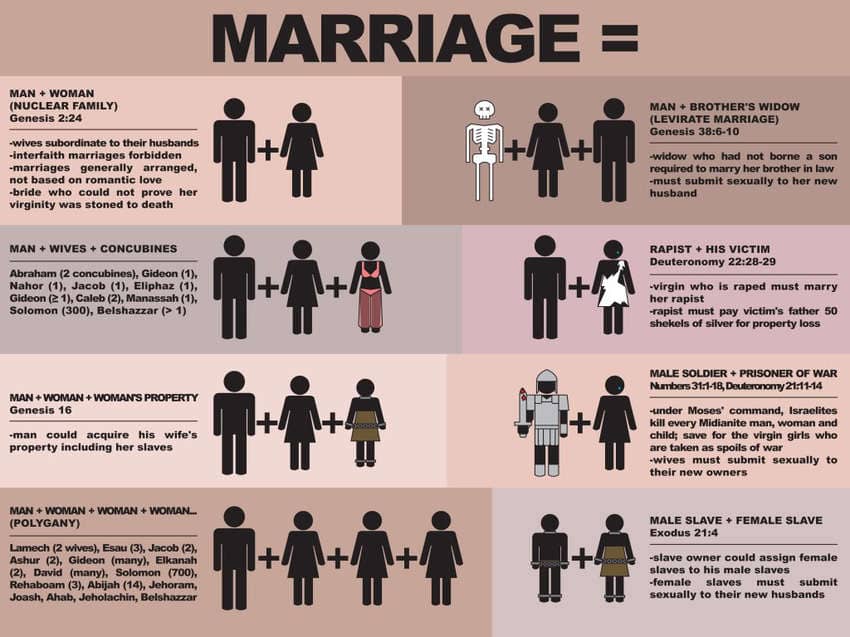
Nuclear Family:
Gen 2:23 (NLT) “At last!” the man exclaimed. “This one is bone from my bone, and flesh from my flesh! She will be called ‘woman,’ because she was taken from ‘man.’” 24 This explains why a man leaves his father and mother and is joined to his wife, and the two are united into one.
The only definition that qualifies as God’s plan for marriage is Gen 2:24; the rest of them are people doing their own thing. In some cases, these things are allowed by God, like polygamy, but almost every polygamous relationship in the Bible involves drama. Paul says that husbands should love their wives as God loves His “wife” (the church). Wives are to love and follow their husbands like the church follows God (Eph 5:21-33, Col 3:18-19). Christ gave his entire being for the church. A man can’t honestly give himself 100% to a bunch of different women, because his loyalty will always be divided. This is why, in 1 Corinthians 7:4, Paul says that a man gives authority over his body to his wife, and the wife gives her body to her husband. There can be no equal exchange of authority over each other’s bodies in polygamy. This is why Jesus points us back to Genesis 2:24 in Matthew 19:4-6, confirming monogamy as the proper and best framework for marriage. 1 Timothy 3:1-6 states that church leaders should be married to one wife, which sets an example for the rest of the church.
Stoning the Virgin:
First, let’s talk about virginity. In Deut 22:13-30, Moses reiterated the sexual purity rules in the Moral Purity laws of Leviticus, but elaborated on them. Many are disturbed when they see that only a woman is punished for her lack of virginity, never the man. However, this law is not against a lack of virginity but instead against initiating a marriage under pretenses, when looking at the broader context of Deuteronomy 22. Learn more about those verses here.
Polygamy and Concubinage:
While polygamy was permitted in the Bible in the Old Testament, it came with certain restrictions. In the New Covenant, however, men are told to have one wife (1 Tim 3:2), mimicking Christ’s relationship with the one church (body of Christ). Polygamy was allowed in the Old Testament because there was only one group of covenant people (the Israelites), and their goal was to preserve until the Messiah came. In the Old Covenant, more covenant people are made through having more physical children, as this covenant is built on blood relations to Abraham. One reason for polygamy is that a man with a barren wife can get another wife who will give him an heir to inherit his land. Land inheritance was a crucial aspect of Israelite culture, as it was designed to ensure that each non-Levite tribe retained its designated territory. If a man’s wife were barren, polygamy would allow him to get another wife and ensure that his line carried on. Polygamy also allowed for levirate marriages so that widows could marry a male relative and produce an heir to inherit the deceased man’s land. If the male relative was already married, then polygamy needs to be allowed so that an heir can be produced. However, there were grievous consequences and familial strife caused in these kinds of relationships, as they are not the original model set up in Genesis 2:24. This is why, in the New Covenant, making more covenant people is accomplished by sharing the gospel, so that people are born again in the Spirit. Therefore, marriage is not necessary or valid in fulfilling the Great Commission. Learn more about Biblical Polygamy here.
Levirate Marriage:
In Deut 25:5-10, we get a definition of Levirate marriage in ancient Israel. In verses 5-6, it says the woman is to marry the brother of the deceased, and the firstborn son of the union would belong to the deceased as an heir. Side note: If he didn’t have a brother, then the book of Ruth reveals that she is to marry the closest male relative (Ruth 2:20 and Ruth 3:10-13). It is clearly shown in verses 7-10 that the man has the right to refuse marriage. When a man does so, he is subject to public humiliation, not death. The purpose of this marriage was to preserve land inheritance, a vital part of the economy that needed to be managed to fulfill the law regarding the return of sold ancestral land on the year of Jubilee, after each set of 50 years (Leviticus 25:8-13, Numbers 36:1-12). In addition, the time left before the next Jubilee year governed the price of land (Lev 25:14-28).
Under the principle of “be fruitful and multiply”, it was necessary to make sure everyone was able to make as many babies as possible to preserve the nation and each tribe’s land allotments until the Messiah comes. Many ancient and some modern cultures around the world still value preserving family lineages and heritage through the bloodline. Levirate marriage was an optional marriage practice that ensured the continuation of someone’s lineage in the promise of the land. In many ancient cultures, these women wanted the honor of having children because it would be considered shameful not to have them. This is why, in Deut 25:5-10, it is the woman who shames the man for not allowing her to produce an heir for her deceased husband. This implies that in most cases, the woman would lose the most if her late husband’s relative rejected her because it is harder for a non-virgin to find a husband than a virgin. Levirate marriage for the woman was a guarantee that she would still have a husband and some social and financial security while also becoming a mother.
In Genesis 38, Judah cheats Tamar out of this opportunity. She married two of his sons, Er and Onan, but they both died. Onan died because he had a levirate marriage with her, but he hated his brother and refused to produce an heir in his name, so he refused to get her pregnant. Judah’s third son, Shelah, was supposed to marry her when he got older, but years later, the time came, and Judah ignored his promise. This was after his wife died. Tamar took matters into her own hands and disguised herself as a prostitute and seduced Judah. She got pregnant, and the people called her out for violating her engagement to Shelah, and Judah wanted to burn her alive (it was an easy way to get out of his obligation to wed her to his son). However, when she asked for payment, she took his staff and identification seal as collateral, and she revealed this collateral on the day of her execution. This made him feel guilty for neglecting his obligation to her, and he agreed to marry her. This suggests that it was the woman’s advantage to have a Levirate marriage, rather than something imposed upon her.
Abraham’s Failure:
Abraham was told he would have a child with his wife and to have faith that God would heal his barren wife, but he and his wife gave up, and he sexually abused Hagar, his wife’s maid, for a child instead. While concubines are allowed under polygamy rules, Hagar was not purchased as a concubine; she was a slave who served his wife Sarah. Also, this whole situation was caused by Abraham’s fears since God never told him to go to Egypt and lie about his wife in the first place. Hagar was given to them as a parting reparation by Pharaoh for almost sleeping with Abraham’s wife, because of Abraham’s deception. God forgives Abraham’s sin because of their covenant, but shows his disapproval of his intercourse with Hagar by letting him know that Ishmael is NOT the promised seed. The situation with Hagar was a result of Abraham and Sarah’s lack of faith in God’s promise, as Sarah had given Hagar to him. In Genesis 17, God makes it clear that all of Abraham’s children will be blessed (he promised a blessing for Ishmael in the previous chapter), but only the one who comes from Sarah (his first wife) will be the promised seed. Abraham has eight children, one with Hagar, one from Sarah, and six more after Sarah dies with his new wife, Keturah (Gen 25:1-5). God’s promised seed was Isaac (Sarah’s son), and God affirmed that by changing Sarai’s name to Sarah (Gen 17:15-22). This shows that God favors monogamy, and even Isaac is monogamous in his marriage. Notice that Abraham never took another wife during the entire time Sarah was alive and barren? We met him at the age of 75, and he remained monogamous throughout that time. Hagar was just a one-time thing. Even with Abraham’s deceptive habits concerning his wife, God prevents the Pharaoh and King Abimelech from sleeping with Abraham’s wife (Genesis 12:10-20, Gen 20:1-18), God secures his covenant with Abraham to prevent him from screwing it up by actively protecting the sanctity of his marriage. This means God didn’t approve of Abraham giving away his wife, or his abuse of Hagar, yet he shows mercy and stays faithful to his promise.
Marrying the Rapist:
Deut 22:28-29 describes what happens in the case of fornication when the woman is not married or engaged. If they are caught, no one is stoned to death (like in the case of adultery), and the man is required to pay her bride price. This gives him the right to marry her, but the marriage will only occur with her father’s approval, according to Exodus 22:16-17. If they do marry, he loses the right to divorce her, which prevents men from sleeping with women and then tossing them aside later. Some translations of Deut 22:28-29 say that a woman must marry her rapist, however, most translations including the KJV, are describing fornication (sex before marriage). In fact, the hebrew words used in this text is not rape. While the scenario can involve rape, marriage is not forced on the victim. A more in-depth article explaining this can be found here.
Conquest Marriage:
As for soldiers taking slave women and such, these were not things God told them they must do, but rather things that were allowed to do. In the ancient world, it was common for women to dress up and look their best when their city or nation was conquered, so that they could woo their conquerors. The purpose was survival, so that they and their children could be protected from living in a desolate wasteland with no army or men to protect the city from wild animals and maintain the infrastructure through dangerous physical labor. Imagine being a single widow in a town with no men. There is no modern construction equipment to close the gap in physical prowess between the sexes, so it would be difficult to rebuild the city’s walls, let alone consider the dangers involved. In addition, one would have to fight lions and bears to defend one’s family, which is usually the men’s job. Likewise, you aren’t trained in traditional male occupations, such as metallurgy, lumberjacking, or sailing and fishing, which are essential for sustaining the local economy. Even if you could sail, who would watch the children while you are at sea? You are the last line of defense for your children. If you have teenagers, their survival chances increase, but if they are young children, they are more likely to die without a guardian. That means avoiding risky behaviors like fighting predators, sailing, and building massive structures. Men did these things because they were more expendable and took on more dangerous jobs. It makes sense in the face of this circumstance to marry your conquerors. Most women wanted to live a soft life, and the best way to guarantee that was to marry a man who took on the hardships of life. More on Israelite Conquest here.
The Sin of Being the Tempter:
There were some cases where these allowances would have been used to preserve a non-Israelite nation that had a blessing from Abraham, like the Midianites. In Deuteronomy 20:10-18, they were instructed not to make peace with the local Canaanite nations and to wipe them out, thereby avoiding the adoption of their practices. Meanwhile, for non-Canaanite nations that were further away, they could offer peace and subjection, and were only to fight if that nation refused to submit. God was explicitly judging the Canaanites, and those who didn’t flee from the land would have been executed. In Numbers 31:9-20, Moses scolds the Israelites for letting all of the women and children live after defeating the Midianites, and then he tells them to take out the women and children and only leave the virgins alive as captives. Why is that? Their sin of seducing Israel into worshiping idols in Numbers 25, to help Moab and Ammon, was a serious offense, and they inherited Canaan’s punishment. The virgin women were women and girls who hadn’t learned the pagan sex practices of the other women yet, so God preserved that remnant of Midian because they are related to Abraham (Gen 25:1-4). Learn more about why this happened here.
Slave Wives:
There is a difference between men and women in terms of liability and risk, as expressed in work and slavery customs. As stated above, men were more expendable, so they were the ones who fought in the war and dealt with more risky life choices (like theft) that could end up in debt slavery, or death. Meanwhile, women, because they produce children they are less expendable, so they are given a certain amount of social protection. Slave women had slightly different rules from men regarding the 6-year limit on Hebrew slaves. Slave women were not likely to be sold for theft like men (Ex 22:3) but were usually sold by their fathers to pay his debt, which is why she goes back to her father when her term is up. This is based on the social protection rules mentioned earlier.
Deuteronomy 15 and Jeremiah 34 say that if a slave wife is unmarried after six years, then she will be free like the men. Meanwhile, Exodus 21 explains that if a slave woman marries the owner or his son, then she becomes a non-slave wife instantly. If she divorces a free husband, then she maintains her freedom even though she started as a slave (Ex 21:11). If a slave man leaves his slave wife, she stays with her master until the 6-year term of her contract is up and goes back to her father since that is the default for unmarried slaves. The males, on the other hand, have to choose between freedom and staying permanently when married to a slave woman given to them by the master (Ex 21:4-6). For men, selling themselves as slaves was a voluntary act and had a term limit; meanwhile, marriage was supposed to be a lifelong commitment (unless there was a contract breach). Since the 6-year term limit on each slave could have been different, the debt obligation came first. If these rules weren’t in place, men could trade their wives in for another every six years, and women could rack up a lot of debt and then skip out on it by simply marrying. More info on slavery in the Bible here.
Adopting Gentile practices:
Israel adopted some practices from other nations at that time, and since the Israelites couldn’t even keep God’s law as it was, he made specific allowances before Jesus came for things like polygamy. In some cases, it was explicitly labeled as sin; in other cases, God allowed it, but there were still consequences of their actions. Similarly, God allowed Gentile nations to worship idols and such in ignorance since they were not in covenant with God. Still, the world is expected to submit to Christ the Messiah now that he has come (Acts 17:30). In some cases, the Israelite leaders abused God’s laws. They used them out of context to oppress the poor (Deut 24:14-15, Amos 2:6-7, Jeremiah 34:8-21), discriminate against foreigners (Ex 22:21-24, Lev 19:33-34, Deut 27:19), and even abandoned their wives for other women through illegitimate divorce practices (Malachi 2:10-17). Jesus made it clear in Matthew 19:3-9 that while divorce was allowed under Mosaic Law, under particular conditions (Deut 24:1, Ex 21:10-11), it was a concession, because of man’s hard hearts. Jesus said this because Jews of his time reinterpreted God’s law about things like divorce by adopting Gentile practices. The Talmud stated that one could divorce one’s wife for burned food or to trade her in for a more attractive wife (Talmud: ‘Gittin,’ 9:10).
Sometimes the Israelites wanted things that God warned them would be bad, but allowed them to have them because they insisted they could handle it, like a monarchy, for example. Originally, the Israelites had a judicial governing system, with judicial leaders and tribal legislators (selected from among the elders). This system was proposed to Moses by Jethro in Ex 18:13. In this system, they even had a female ruler named Deborah (called the “Mother of Israel”). However, they wanted a King because other nations around them had kings, so God allowed them to have a King as a concession for their misdirected faith in human leaders. God warned them about the problems with a monarchy, but they wanted one anyway, and he let them have it (1 Samuel chapter 8). They chose King Saul as their first king, which ultimately led to the nation’s failure, confirming God’s judgment about monarchies and the dangers of trusting in man’s system of government.
Throughout the Old Testament, the prophets use the analogy of marriage to represent Israel’s covenant relationship with God. Oftentimes, it’s used to compare idolatry to adultery. Worshipping idols was cheating on God because they made a covenant with him and him alone. Like Ezekiel 23, where Ezekiel compares Israel and Judah to two adulterous sisters. One notable book that does this is the book of Hosea. In Hosea 1-3, Hosea becomes a living metaphor who marries a promiscuous woman who abandons him for other men. However, instead of divorcing her or having her killed for catching her in adultery, he takes her back and forgives her at God’s request. Then God says, just like this, he is going to take back Israel after the exile, forgiving them of their idolatry and restoring them as his “wife”. This is where the New Testament picks up the analogy, referring to the church (the body of believers in Christ) as the bride of Christ, and Paul says that husbands should love their wives as God loves His “wife” (the church). Wives are to love and follow their husbands like the church follows Jesus (Eph 5:21-33, Col 3:18-19). In Ephesians 4:4-6, Paul states that the Body of Christ is one body united by one Spirit, serving one God. Therefore, if the analogy is to work, then one woman is to be dedicated to one man and vice versa, as it says in Genesis 2:24.
New Testament:
In the New Covenant, we now have the Holy Spirit dwelling within us, making us living temples of God’s presence, which means we should live holy lives, avoiding sexual sin (1 Corinthians 6:18-20). The Holy Spirit helps us overcome sin (Galatians 5:16, Galatians 6:7-9). In the Old Covenant, they did not have the Holy Spirit, so God allowed certain practices under strict supervision as outlined in the Torah. Moses and Jeremiah said the solution to man’s inability to keep God’s law was to get our hearts “circumcised” or softened (Deut 30:6, Jer 4:4). Ezekiel told us this would happen when God poured out his spirit on us (Ez 36:25-27) and Joel reveals what this would look like in Joel 2:28-32. This even happens on Pentecost (Shavuot), 50 days after the resurrection of Jesus, as described in Acts 2:16-21, and Paul assures us that this was the heart circumcision Moses was referring to (Rom 2:29, Col 2:11).
In the New Covenant, marriage is not considered a requirement, as we don’t make new kingdom members by having children, but rather by sharing the gospel. Therefore, the preservation of tribal land allotments and the existence of a specific people are not the goals; polygamy is not necessary. Jesus confirmed the option of being a eunuch in Matthew 19:11-12 when discussing people who were made eunuchs (forced castration), born eunuchs (intersex), or who made themselves eunuchs (voluntary castration or will power) for the sake of the Kingdom. In the Torah, castration was frowned upon (Deut. 23:1), but in the New Testament, it is not. Paul was a celibate eunuch and even encouraged being celibate in his letter to the Corinthians when talking about marriage (1 Corinthians 7). However, he never required it, and even suggested getting married if a person can’t control their sexual desires. He recommends celibacy so that Christians can focus on the work of the Kingdom, as single people can concentrate on the Lord’s work without the distractions of familial obligations.
Jesus defined marriage in Matt 19:4-6, and he quotes Genesis 1:27 and 2:24. He says, “4 “Haven’t you read the Scriptures?” Jesus replied. “They record that from the beginning ‘God made them male and female.’[Gen 1:27]” 5 And he said, ‘This explains why a man leaves his father and mother and is joined to his wife, and the two are united into one.’[Gen 2:24] 6 Since they are no longer two but one, let no one split apart what God has joined together.” This is the only marriage definition endorsed by Christ Himself.