Is God one person or three persons? The Bible says God is one (Deut 6:4). Yet the Gospels suggest Jesus claimed to be God in the flesh. John 1:1-14 says, In the beginning was the Word, and the Word was with God, and was God, and the Word became flesh as Jesus. Matthew 1:23 quotes from Isaiah 7:14 and Isaiah 8:8-10, stating that a virgin will conceive a child, and his name will be Immanuel (meaning “God with us”). Lastly, Daniel 7:13 alludes to a messianic king called the “Son of Man,” who descends from heaven and rules the world. Jesus refers to himself as the Son of Man in many places, such as in Luke 5:24, where he demonstrates that, like God the Father, he has the authority to forgive sins. The Holy Spirit that came upon Jesus (John 1:32-34) is given only to those who believe (John 14:16-17), and this “Holy Spirit” is the spirit of God. Yet, Jesus said that the Father will send the Spirit in John 14:16-17, but in John 16:7, He says He will send the Holy Spirit. Does this show that Jesus and the Father are “one,” as he says in John 10:30?
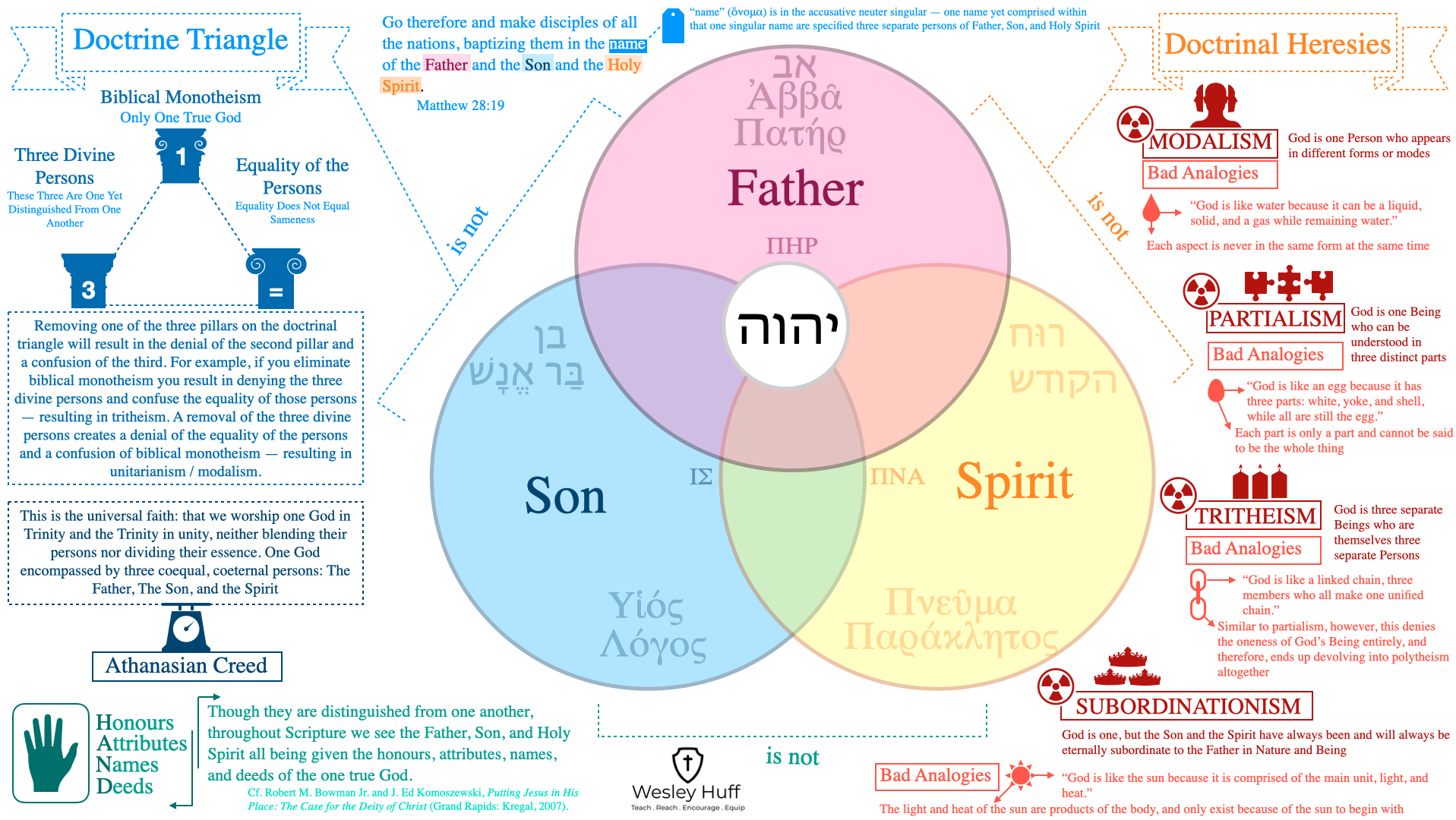
There are many interpretations and explanations for the Trinity, and I’ve encountered the following categories: the Trinity, Modalism, Partialism, Tritheism, and Subordinationism. Other terms mix these definitions, but these are the most diverse sets of terms on the spectrum.
Trinitarianism is the classical Christian view of God, which holds that the Father, the Son, and the Spirit are coequal, coeternal, and unified as three persons in one being.
Modalism believes that God operates in different modes, much like the states of matter. A typical analogy is that of water, which can exist in three states: solid, liquid, or gas. Likewise, God exists as the Father, the Son, and the Spirit, and they are never all three present simultaneously.
Partialism asserts that God is a single being that exists in three distinct parts, much like an egg (shell, egg white, and yolk) or an apple (stem, skin, and core).
Tritheism asserts that God is not a single being but three separate beings operating as a council. It is like a link chain where each person is linked, but they are separate beings. This can be turned into polytheism.
Subordinationism says that the Father is superior to the Son and the Spirit.
Can three individuals “be one” but separate at the same time? The Spirit operates in unity with the Father and the Son, but we see the Spirit descend upon the Son at baptism (Matt 3:13-17, Mark 1:9-11, Luke 3:21-22, John 1:32-34) and later upon his disciples at Pentecost after the resurrection. Interesting right? Also, Jesus, as the human Son, is not omniscient because the Father can withhold knowledge from the Son and the Spirit. In Matthew 24:36, when asked about his future return, Jesus said that no one, not even an angel or the Son of God, knows this information, but only the Father. In Matt 20:20-23, when James and John asked who would be next to Jesus in the kingdom, Jesus didn’t know the answer. He said this was something only God decided (Matt 20:20-23). In addition, 1 Timothy 2:5 says, “For, there is one God and one Mediator who can reconcile God and humanity—the man Christ Jesus.” Jesus is distinguished from the Father because he is the mediator between the Father and humanity.
Whether or not a person believes they are the same, expressed in three modes or three separate individuals, the consensus is that they never conflict or contradict one another and are in perfect harmony. The root of all these ideas is found in John 1:1, which states, “The Word was God, and the Word was with God.” That, however, presents a paradox: How can the word be “with God” and “be God” simultaneously? This is what makes the subject so complicated.
Some say that, yes, Jesus was part of God initially, but he only became the Son when he was born as a human, so the setup may have changed with the Son’s birth. One question that comes from this is, can we observe the Son of God in the Old Testament besides prophecy? There’s no sinless human in the Old Testament, so we don’t see God the Son manifest in the Old Testament exactly. The Son was born in the first century, marking the beginning of His existence on earth as a separate person. Therefore, God the Son didn’t exist until He was born, right?
On the contrary, there is scriptural evidence that Jesus existed before he was born; Jesus himself even says that he existed before Abraham was born (John 8:54-59). Whenever we see visions of God’s throne, we don’t see His Son seated at His right. However, we know that the Son existed alongside the Father before he came into the world based on John 1:1 and John 17:5 and 26. One could argue that the only way for John 1:1 to be true is if they are the same rather than two separate individuals. Matthew 1:22-23 references a prophecy from Isaiah 7:14, which states that a virgin will give birth to a son named Immanuel, meaning “God with us.” Matthew’s Gospel shows us that Immanuel is connected to Jesus because his mother, Mary, conceived him as a virgin; thus, Jesus is “God with us.” In John 10:30, Jesus says, “The Father and I are one,” so according to the point of John’s Gospel, Jesus is God.
Keep in mind that John also says the word was “with” God in John 1:1. Let’s reframe what if the statement, “the Father and I are one”, is an analogy comparable to a married couple “being one flesh”, even though they are two individuals. In Ephesians 4, Paul says: “4 For there is one body and one Spirit, just as you have been called to one glorious hope for the future. 5 There is one Lord, one faith, one baptism, 6 one God and Father of all, who is over all, in all, and living through all. 7 However, he has given each of us a special gift through the generosity of Christ.”
This oneness doesn’t mean all believers are fused into one physical body, but rather that they operate together as a united movement, according to the ways of the Spirit, as if they are one entity. Jesus talked/prayed to the Father as if he were in a separate location from him. In John 8:28, Jesus states that everything he does is what his Father has instructed him to do, implying that the Father is issuing orders from elsewhere. Jesus also references the Spirit as someone who will replace him on Earth when he ascends (John 14:26). The Spirit is not limited by space and time, unlike the human Jesus, yet Jesus has to leave Earth for the Spirit to come. Some can conclude a Tritheism view from this, which means they are separate gods working together as a council. This, however, conflicts with the idea that God is one (Deut 6:4-5).
Some scriptures to ponder: John 14:7-13 alludes to Jesus as the Father because when Philip asks Jesus to show them the Father, Jesus replies that since they’ve seen him, they’ve seen the Father. In John 14:16, Jesus said that the Father would send the Comforter, but in John 16:7, Jesus said He [himself] would send the Comforter. Did Jesus lie? No, it is a true statement if Jesus and the Father are operating as one. In John 1:32-34, God says to John the Baptist, ‘The one on whom you see the Spirit descend and rest is the one who will baptize with the Holy Spirit.’ This is when the Holy Spirit descended upon Jesus as John the Baptist baptized him. The Father sent him to rest on Jesus at baptism, and Jesus will send him to his disciples after he leaves because Jesus is the one who “baptizes us with the Holy Spirit.” They both promise to send the Holy Spirit to followers of Christ, so John references each of them interchangeably. Jesus and the Father are separate persons but united in essence as one being. This doesn’t mean they are separate beings. A being is a what, a person is a who, so God the Father, Jesus the Son, and the Holy Spirit are three separate whos (persons) but one what (being).
One thought experiment proposed by the Modalist view is that God is like water. Water can exist in three states: solid, liquid, and gas. If you have a sealed container of liquid water and you heat it or freeze it at certain temperatures, the water will change to vapor or ice, respectively. So who is to say God can’t change states and still be the same God? Since God is omnipresent, he has access to all locations in space and time (past, present, and future). Allowing him to be in all states simultaneously so the Son can pray to the Father while being filled with the Spirit. The thing is, Jesus, as a human on earth, is not omnipresent because he has a human body and can only be in one place at a time, which limits the modalism analogy.
A unique set of conditions can allow water to exist in all three states simultaneously; this is known as the Triple Point of Water. It’s the point at which water, subject to the right temperature and pressure, can simultaneously exist as a solid, liquid, and gas. Even with that, one body of water features all three states simultaneously, but different parts of that body of water are operating in those states. This means that one would see liquid water boiling alongside unmelting ice. The triple point analogy may be more consistent with scripture than the modalism analogy since the ice, water, and vapor are all in the same system, yet, visually, one will see ice, bubbles, and steam (separate states co-existed in the same space because of thermodynamic equilibrium). Likewise, the Father, Son, and Spirit are united as one being, but each is still separately visible because of its distinct attributes. The Son did for our sins, but the Father and Spirit do not die. The Spirit inhabits the bodies of believers, but the Father and the Son do not. The Father answers prayers; this is why Jesus told us to pray to the Father (Matt 6:9-13, John 16:23-24).
Those in the Partialism camp can use this analogy if the ice, water, and vapor are viewed as separate parts of a single body of water, much like an egg is composed of a shell, egg white, and yolk. Partialism is saying that they are each only parts of a whole (each one is 33% God) rather than each being a full expression of God. That conflicts with the understanding that Jesus is fully God and fully man, known as the hypostatic union, so Partialism is not the answer. Jesus as God the Son is the most unique person of the Trinity. Phil 2:7-8 says he let go of his full divine privileges so that he could walk among us and share our limitations, distinguishing him from both the Father and the Spirit and the rest of humanity. Being human means he can be born as a descendant of Adam and is related to us, can be tempted like us, and die like us; and these are attributes that neither the Father nor the Spirit has. However, as God the Son, He has access to perfect communication with God the Father and has even seen God the Father since He came from heaven, so there is no other person like Him.
Furthermore, there is the Subordinationism argument, which posits that God the Son and the Spirit are subordinate to the Father, typically based on the conclusion of John 14:28 or 1 Corinthians 15:27-28. John 14:28 says, “Remember what I told you: I am going away, but I will return to you again. If you loved me, you would be happy that I am going to the Father, who is greater than I am.” Jesus is saying that the Father is greater in office, function, and position, not in essence, nature, or character. A human father and son are both equally human, but the father has a different position. The President of a country is equal to their citizens in terms of rights as individuals, but holds a greater position while in office. The Father and Son operate in different functions; the Father doesn’t die for the sin of humanity, but the Son does. The Father raises the Son from the dead; the Son doesn’t raise himself (Rom 10:9).
In 1 Corinthians 15:27-28, Paul states that Jesus was given all authority over everything except God, because God the Father is the one who delegated authority to Him. Was Paul saying that Father has authority over him? What about the Holy Spirit? Is Jesus over the Holy Spirit? That verse is being used out of context since the topic of discussion in the preceding verses is about how Christ will return in the end to deal with all evil, including death itself. The entire chapter is about the resurrection of the dead and why followers of Christ must believe in Christ’s resurrection, because they will also be resurrected as joint heirs of eternal life. All things we need to be delivered from are under the authority of Christ to receive eternal life. Jesus is equal to the Father, but not greater than, so he doesn’t have dominion over the Father or the Spirit. The relationship between the Father, the Son, and the Spirit is not even on Paul’s mind in this letter. Paul is referring to the fact that Jesus has the authority to forgive sins (Matt 9:1-8, Luke 5:17-26) and to judge (John 5:19-23). The Holy Spirit is sent in the name (authority) of Jesus (John 14:26). Only believers in Christ who are saved (which means they are forgiven) have the Holy Spirit (John 14:17, John 16:7-11, Rom 8:5-9). In the book of Acts, people are healed and delivered as the gospel is spread, a result of the power of the Holy Spirit, indicating that they are forgiven when they believe the gospel. Therefore, neither Jesus nor the Holy Spirit is subordinate since they have the same authority as the Father.
Let’s look at the scriptures of God delegating authority to another:
In Ex 23:20-21, the “Angel of the Lord” in the Old Testament is distinct from God himself, yet he is given authority to judge the Israelites.
Ex 23:20 [NLT] “See, I am sending an angel before you to protect you on your journey and lead you safely to the place I have prepared for you. 21 Pay close attention to him, and obey his instructions. Do not rebel against him, for he is my representative, and he will not forgive your rebellion.
The Angel of the Lord is often pointed to as the pre-incarnate Christ in action. God the Father assigns authority to a spiritual being that is not him to do things he would normally do. There are other strange instances where God refers to Himself in the third person or speaks through what appears to be an angel, as seen in Genesis 18, where Abraham is talking to three men. Two of them (later revealed to be angels) go to Sodom and Gomorrah to rescue Lot in the next chapter. The third one, “the Lord,” remained with Abraham as he pleaded for God to spare those cities. In Genesis 32, Jacob gets the name Israel, which means “God strives” or “prince of God,” after wrestling with a man who appears to be an angel from heaven. The mysterious humanoid figure in both Genesis 18 and 32 can be viewed as a pre-incarnate Christ; therefore, the statement about Christ meeting Abraham in John 8:58 appears to be a direct reference to Genesis 18. This shows that God can delegate his status to another heavenly being (like the Angel of the Lord, or a pre-incarnate Christ), who appears as a human on earth in the Old Testament.
The New Testament reveals God doing the same with Jesus. It says things like “This is my dearly loved Son, who brings me great joy. Listen to him.” (Matt 17:5, Mark 9:7, Luke 9:35), and later in Matt 9:1-8 & Mark 2:1-12 when heals the Paralyzed man, he says “Be encouraged, my child! Your sins are forgiven”. The Pharisees responded by saying he blasphemed because only God can forgive sins. Jesus replied, “Is it easier to say ‘Your sins are forgiven,’ or ‘Stand up and walk’? So I will prove that the Son of Man has the authority on earth to forgive sins.” Then the man was healed in front of a crowd of people (Matt 9:5-6, Mark 2:9-10).
When the religious leaders criticized Jesus for healing on the Sabbath (John 5:19-23), Jesus said, “19 So Jesus explained, ‘I tell you the truth, the Son can do nothing by himself. He does only what he sees the Father doing. Whatever the Father does, the Son also does. 20 For the Father loves the Son and shows him everything he is doing. In fact, the Father will show him how to do even greater works than healing this man. Then you will truly be astonished. 21 For just as the Father gives life to those he raises from the dead, so the Son gives life to anyone he wants. 22 In addition, the Father judges no one. Instead, he has given the Son absolute authority to judge, 23 so that everyone will honor the Son, just as they honor the Father. Anyone who does not honor the Son is certainly not honoring the Father who sent him.”
So, Jesus has the authority to forgive and judge, and this right belongs to the Father; therefore, he can only have it if the Father has entrusted him with this right.
Paul even discusses the delegation of authority to Jesus in his letters (Eph 4:21-22, 1 Cor 15:27-28, Col 2:10). He doesn’t have to be God the Father to possess his authority and power, because God the Father can share this right. Jesus then delegated the power to operate on earth through the Holy Spirit after He left (John 14:15-21, John 16:5-15). We see one moment where the Holy Spirit executes judgment against Ananias and Sapphira, causing them to die in Acts ch. 5.
John 16:5 [NLT] “But now I am going away to the one who sent me, and not one of you is asking where I am going. 6 Instead, you grieve because of what I’ve told you. 7 But in fact, it is best for you that I go away because if I don’t, the Advocate (the Holy Spirit) won’t come. If I do go away, then I will send him to you. 8 And when he comes, he will convict the world of its sin, and of God’s righteousness, and of the coming judgment. 9 The world’s sin is that it refuses to believe in me. 10 Righteousness is available because I go to the Father, and you will see me no more. 11 Judgment will come because the ruler of this world has already been judged. 12 “There is so much more I want to tell you, but you can’t bear it now. 13 When the Spirit of truth comes, he will guide you into all truth. He will not speak on his own but will tell you what he has heard. He will tell you about the future. 14 He will bring me glory by telling you whatever he receives from me. 15 All that belongs to the Father is mine; this is why I said, ‘The Spirit will tell you whatever he receives from me.’
In conclusion, the Father sent Jesus to take on the consequences of our sin, which is death, then Jesus rose and ascended to prepare for the Kingdom of Heaven’s conquest of Earth, and in the meantime, He sent the Holy Spirit to do God’s will on earth and bring people into the Kingdom by faith through evangelism by believers filled with the Spirit of God. Both the Son and the Spirit serve God’s will without fail and even share his authority. They are all part of the one God, rather than three separate Gods, but have distinct personalities and attributes that differ from one another. Essentially, YHWH (the God of the Bible) is one being, which is three co-equal, co-eternal, united persons (the Father, the Son, and the Spirit).
God the Father’s presence hovered above the Ark of the Covenant (Ex 25:22) in the Jerusalem Temple until the Babylonian Exile. Then Jesus was born as God’s representative on earth, filled with the Holy Spirit after being baptized (Matt 3:16-17), and operated in most of the gifts of the Spirit (1 Cor 12:8-11). He did the work of God on Earth (John 6:35-40) until the crucifixion, resurrection, and ascension. Hebrews ch. 5-7 explains that Jesus now functions as a high priest for believers in heaven, mediating this new covenant.
Meanwhile, on Earth, we communicate with him through the Holy Spirit. The Spirit came upon his followers at Pentecost and dwells with them now until his return (Acts ch. 2, Acts 8:14-16, Acts 10:44-46, and Rom 8:5-11). This suggests that while God is a single being, He can present Himself through three distinct operating persons while functioning as one authoritative figure. Therefore, the Trinitarian view is most compatible with scripture. It features the attributes of the other views without being as exclusive as the others. Of course, there is likely more to this than we can comprehend on this side of eternity. We will fully understand one day in the “world to come” when everything is made clear.
Resources:
The Bible Project attempt at explaining the Trinity/Triune God
Infographic from Wesley Huff explaining the Trinity
An article exploring the Jewish understanding of this concept