

Who wrote the Bible? Did the Bible copy from pagan myths? Are there alterations? Why should we trust it? How was it constructed? Can we trust it as a historical book? This is an exploration of how some of the books in the Bible may have been compiled based on literary design and a comparison with other legends. Some books have specific authors associated with them who write from their perspective, but others do not, as they are compilations. There are many different theories on how the Bible was constructed, but this is how I connect the dots.
Moses is credited with writing the Torah, which is the first five books of the Bible (Genesis, Exodus, Leviticus, Numbers, Deuteronomy). Exodus through Deuteronomy were all written by Moses in his era, with a few annotations added by later authors after Moses’ death; however, Genesis is about events that predate Moses, so how did he write it?
It seems likely that Joseph compiled a pre-Moses version of Genesis from the stories passed down to him by his father, Jacob, and their forefathers, going back to Noah. In Genesis, there are 12 chapters dedicated to Joseph’s story, and much less is written about Isaac and Jacob. Abraham receives a significant portion (13 chapters) of Genesis, but he is a central figure in the whole faith, so that makes sense. Joseph may have even had some tablets from before the time of Abraham (that may have come from Melchizedek), for Genesis 1-11. Joseph was a Hebrew slave who was brought to Egypt after being sold by his brothers, who eventually became the vizier of Egypt. Moses worked and was raised in Pharaoh’s house for the first 40 years of his life before he fled to Midian as a fugitive, wanted for murder. Since Moses was raised in Pharaoh’s house, he likely read and wrote in Egyptian, which means he was able to read Joseph’s records from the many decades that had passed. Both would have been bilingual; in fact, Gen 46:21-24 reveals to us that Joseph was bilingual.
The first eleven chapters of Genesis are from before Abraham’s day, and that section features the creation story, the fall, the flooded world, and genealogies that connect the pre- and post-flood worlds. We can see further evidence of pre-Genesis writing with the use of toledoth passages (‘These are the generations of …’), which seem to reference an external list of historical records of previous generations. Genesis 5 and 11 use the phrase “these are the generations of” when listing out the genealogies of Adam to Noah and Noah to Abraham, respectively. This section could also have been entirely based on oral tradition, all the way down to Joseph. However, the main point is that Moses wrote the version of Genesis that we are familiar with, even though its events occurred before Moses’ birth by over 200 years. Since much of Genesis is oriented toward Joseph’s perspective and concludes with Joseph’s story, Moses likely obtained some of the information from Joseph’s writings; anything else would have been revealed directly by God. In addition, Moses added annotations regarding place names and other details. For example, in Genesis 2:10-14, he provides us with the names of rivers that flowed from Eden, along with the names of these rivers and the direction they flowed, indicating the countries they flowed towards.
Gen 2:10 (NLT) A river flowed from the land of Eden, watering the garden and then dividing into four branches. 11 The first branch, called the Pishon, flowed around the entire land of Havilah, where gold is found. 12 The gold of that land is exceptionally pure; aromatic resin and onyx stone are also found there. 13 The second branch, called the Gihon, flowed around the entire land of Cush. 14 The third branch, called the Tigris, flowed east of the land of Asshur. The fourth branch is called the Euphrates.
The nations mentioned (Cush, Asshur, etc.) don’t exist yet, as they are named after descendants of Noah from the Tower of Babel in Genesis 11. The annotations enable readers and hearers (the Israelites who sojourned in the wilderness and later) to visualize and locate these places that have been long lost to history. The Earth was terraformed in the flood, so the landscape is different. Rivers originate from mountains and flow into other water bodies, such as the ocean, implying that the Garden of Eden was located on a mountain. This would support the idea that the Tower of Babel was an attempt to create an artificial version of the Garden built on an artificial mountain (tower or step pyramid), and it was constructed where Noah would have said the Garden used to be, somewhere in the plains of Shinar (Babylon). The text uses the present-day (of Moses’ time) place names to talk about past events.
Similarly, there are annotations about the name of the region of Bethel (House of God) in the stories of Abraham and Joseph. However, we find out that Bethel was first called Bethel by Jacob in Genesis 28:19 after Jacob had the dream of angels going up and down from heaven. The text tells us here for the first time that the place was initially called Luz by the Canaanites. That means that at the time of Abraham and Isaac, it was called Luz, but it was called Bethel for most of Genesis because that is the name Jacob (also known as Israel), the forefather of the Israelites (the audience), gave it. Genesis was written and preserved for the original audience of the Israelites at the time of Moses, so specific details are not written with the original names intact for their understanding in later history. Even after Moses’ death, in Joshua 16:2, 18:13, and Judges 1:23-26, Luz is mentioned because the original inhabitants continued to refer to it by that name. However, there is also a reference to it being called Bethel, as that is what the Israelites referred to it as. Just as in the modern, globalized world, every nation has a different name depending on the language spoken when referring to a country. Whether these annotations were made by Moses or later scribes and compilers from the 2nd Temple Period of Judaism is debated, and it is possible that both contributed on a case-by-case basis for each one.
The book of Judges is the same. Samuel or someone from his era likely compiled it together, since the events in it precede Samuel’s birth. Samuel could not have written the book of Samuel, because Samuel died midway through it. The Book of Samuel, which deals with King David’s reign, was compiled by later authors who used source texts to compile the stories. The sources are listed in 1 Chronicles 29:29, which states, “All the events of King David’s reign, from beginning to end, are written in The Record of Samuel the Seer, The Record of Nathan the Prophet, and The Record of Gad the Seer.”
Judges 18:30 even tells us that Micah’s idol was worshipped by the tribe of Dan “until the exile”. This refers to the conquest and exile of the Israelites by empires such as Assyria and Babylon, which occurred around 3-500 years after the events of Judges, so this annotation was added after the exile. It seems evident that chroniclers recorded many historical narratives of the Bible, and later composites were created, most likely after the exile, to preserve key elements of these narratives.
The same is true for the Book of Psalms; the book is a compilation of 150 songs written by various authors, and at least 73 of them are attributed to David. Some of them are analogous but attributed to David out of tradition. Sometimes, Jews in the first century, as evidenced by the Dead Sea Scrolls and even New Testament authors, such as in the book of Hebrews (Heb 4:7), refer to the Psalms in general as David’s writings. Heb 4:7 quotes Psalm 95:7-8, which doesn’t have an author assigned to it but refers to it as the writings of David. The book of Psalms is divided into five sections, and each section has a different set of authors.
The first section is Psalms 1-41. Psalms 1 and 2 have no headings referring to an author. Psalm 3-41 is the first section of five, and most of these Psalms are attributed to David, with a few unspecified Psalms, such as Psalms 10 and 33.
The second section has multiple authors, including David (Ps 42-72). The authors are the sons of Korah (Psalm 42-49), Asaph (Psalm 50), David (Psalm 51-71), and Solomon (Psalm 72). Psalm 72:19-20 concludes this section, stating that this is the end of the Psalms of David, son of Jesse. This suggests that, at one point, the Book of Psalms had 72 chapters, but later, additional chapters were added.
Section 3: Ps 73-89 were written by Asaph, a choir director (Ps 73-83), the sons of Korah (Ps 84-85, 87-88), David (Ps 86), and Ethan the Ezrahite (Ps 89). Section 4: Ps 90-106 were written by Moses (Ps 90), not specified but likely David (Ps 91-100, 102), and David (Ps 101,103-107). Section 5: Psalms 107-150 were written mainly by David, with a few unspecified chapters that appear to be by David. One exception is Ps 127, which is attributed to Solomon.
More evidence of this can be found in Proverbs 25, which notes that this section of Proverbs was compiled by the advisers of King Hezekiah, thereby distinguishing it from the previous collection of proverbial sayings that begins in chapter 10.
The Books of Kings, like the Chronicles pair, have references to larger books that contain more detail. The Book of Kings usually ends each section with “and the rest of XX’s reign was recorded in the Book of the Kings of Israel/Judah”. This suggests that some books preserved in the Tanakh (Old Testament) are summaries of information from other sources, highlighting key events.
Some secular scholars will say the whole Bible was written post-exile based on a bunch of Ancient Near East myths and legends. It’s usually claimed that the Bible was written around 400 BC, while Israel was under Persian rule. Similarities can be found between the creation story in Genesis 1-3 and the Enuma Elish (Babylonian creation story). Skeptics often say that means the Bible is plagiarized. One must realize that if these events are actual, then multiple sources will have a version of these stories, so it would be expected that, since everyone descends from Noah, they would all have the same story. The same claims are made about the similarity between Noah’s flood story in Genesis 6-11 and the Epic of Gilgamesh (the Mesopotamian flood story).
The similarities are not just between the Bible and other Ancient Near Eastern myths. These similarities span various flood stories around the world. They involved gods causing a great flood, and some people being saved in a boat.
– The Epic of Gilgamesh mentions how Utnapishtim, his wife, relatives, and baby animals survived a flood caused by the gods by building a boat.
– Tapi and his wife, in Aztec tradition, took animals on a boat to survive a flood.
– An Incan flood story tells of how Viracocha (the god) caused a flood to wipe out giants. Manco Cápac, the founder of the Incan civilization, and his wife survived by floating in a box.
– Nu’u, in one of the Hawaiian traditions, built a giant canoe to survive a great flood.
– The Hindu story of Matsya is about Vishnu causing a great flood but preserving Manu and the seven sages (Saptarishi) and animals in a boat.
In the Chinese language, the character for “boat” is made of characters that reference “8 people in a boat”. The character for “boat,” 船, is composed of three characters. 舟 means vessel, 八 means 8, and 口 means mouth or person. Noah, his wife, his three sons, and each of their wives made eight people, and they were on the Ark. Image below.

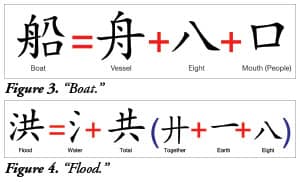
These and others echo the story of Noah’s Flood. It’s almost as if there is a collective memory of a historical event, rather than people simply stealing each other’s work and disseminating it around the world thousands of years before the advent of globalization. The variations would be due to the fracturing of language at the Tower of Babel, as described in the Book of Genesis, chapter 11—something to think about.
There are other theories that Israel was never a single nation before the exile and that the Genesis story originated from Judah, while the Exodus story originated from Israel. These stories were united under Persia to create a false history of a united nation. Usually, this is based on the J, E, D, P, R theory by Julius Wellhausen (1844–1918), which posits that there are five distinct authors of the Bible and that the Bible evolved in stages, with the books never being original, complete documents. This suggests that Judaism was originally another polytheist, animist, pagan religion that evolved into what it is today over time. The Bible morphed along with it to suit the later cultural needs. J and E are in reverence to the names of God used J(Jehovah/YHWH), and E (Elohim). It is believed that two different authors used two different names for God. However, when considering the context of usage, Genesis 1 employs the title Elohim, which refers to God as the creator, and Genesis 1 is about the cosmic creation. Whereas Genesis 2 is localized to the personal interaction of God with the first humans, it makes sense that this is the first use of YHWH/Jehovah, since this is God’s personal name revealed to Moses. The D is about the Deuteronomist, an author from the time of King Josiah, who is believed to have written the book of Deuteronomy. This is based on the story in the Bible where King Josiah rediscovered the Torah while cleaning out the Temple, after many years of abandonment due to the idolatry in Israel that his predecessors had initiated. He led Israel to repent (2 Kings 22-23). The book he found is believed to be the Book of Deuteronomy. Deuteronomy is referenced in the books of Joshua and Judges as Moses’ writing, yet according to this theory, it is dated to around 600 BC. The P refers to the priest, from post-exile temple Judaism. It is believed that they wrote several works to tie the whole Bible together around that time, creating the foundation of modern Judaism. Then R is the revisionist who went in and cleaned it up and compiled it a few hundred years before the 1st century AD.
JEDP theory assumed that the Israelites were 100% illiterate and had to wait hundreds of years before writing their law and their foundation history. However, the Torah’s narrative itself was chronicled as they went through the wilderness like a diary. In addition, Moses was likely literate, having been raised in Pharaoh’s house in Egypt, where he likely used either the Egyptian or proto-Sinaitic script (a precursor to the Semitic alphabet) to write these things. Additionally, the Torah employs several Egyptian words and references cultural practices that date back to the 2nd millennium. Lastly, Moses even wrote annotations on place names alongside the ancient ones to indicate name changes to his original audience, using phrases like “to this day.”
More on Egyptian words in the Tanak here.
This idea reminds me of an old theory that King David didn’t exist, but David’s existence has been confirmed in recent years by archeological finds like the Tel Dan Stele and the Mesha Stele. Claims can be made here and there, but if they are not backed by evidence, they are just theories. Some anti-biblical theories have been debunked by newly discovered evidence. Bible skeptics will always have their theories until they encounter new archaeological evidence that disproves them.
My point in writing this is to say that the Bible didn’t need to be written in this perfect linear fashion to be true. It would be more suspicious if it were because that would be the work of one person at one time telling a story. Yet, upon closer examination, the text reveals a diverse range of cultural and historical settings across the various books of the Bible. It is a compilation of various writings from the perspective of a persecuted minority in Israel, the prophets. The same is true of the Gospels; Mark and Luke are not eyewitnesses of the events they record, so they gathered eyewitness testimony. John and Matthew, on the other hand, are apostles themselves and interacted with Jesus himself. Yet all four Gospel accounts are valid records of Jesus’ life, teachings, and the revelation of who He said He was, according to the prophecies of the Tanakh (Old Testament). Despite being a compilation, the Bible is harmonized by a consistent belief in and worship of the one God and of Israel, even though community preference for worshipping idols and engaging in pagan practices at different times resisted its influence. Each author has their own specific motives and writing style, but the main concept is that the Spirit of God moves them. This doesn’t mean God took control of them and forced them to write something they didn’t know. What it means is that each person who was moved to write wrote about what was essential to the people of their generation, and often used preserved sources to gather information. The author’s views are usually opposed to the community, which has moved on from worshiping the God of Abraham and is breaking the commands. This is why these prophets are usually persecuted and even killed.
None of the above is a threat to the historicity of the Bible. No history book is actually written in a perfectly linear fashion. Things are categorized based on subject and theme. For example, a US history book about the 60s will have a lot of cover in that decade, but rather than writing a linear story with overlapping major events, it will divide the story into parts like “The Civil Rights Movement”, “The Cold War”, “The Space Race”, etc. These things are collections of interrelated stories that happened in the same era, but the presenter must present them in a way that readers can digest. This is how the Bible is written, except that it has around 40 key authors, plus annotators, and spans over 1,500 years. Therefore, annotations and commentary will be included to inform readers of new copies about changes in city and regional names, as well as the relationships between certain ethnic groups, and so on. All these things are essential components of the preservation process. Copies need to be made because animal parchment and papyrus leaves are organic and will decay if not preserved under the right conditions. Keeping the scriptures in the right conditions wouldn’t have been feasible when they were expected to be read aloud, and every copy was considered holy and to be put to use. The historicity of the Bible is not under threat because it is a compilation with updates, nor is it threatened by similarities with other cultures in the region.
Resources:
CMI – Did Moses Write Genesis?
CMI – Who Wrote Genesis?
Tel Dan Stele – Wikipedia
Mesha Stele – Wikipedia
6 Archaeological Finds that support the bible
Flood stories:
Crash Course – Meso American Flood Stories
A discussion with Nick Liguroi author of Echoes of Ararat
Epic of Gilgamesh vs Noah’s Ark
ICR – Flood tradition similarities around the world
ICR – Chinese characters and the bible
CMI – Chinese characters and bible – defense
AiG – Noah’s of various cultures
AiG – Australian Aborigines flood story
AiG – Comparisons of Various Flood Legends
AiG – Scientific evaluation of various flood accounts
AiG – Worldwide Flood legends
Ancient Egypt Flood Story:
” Chapter 175 of the Egyptian Book of the Dead is one example. This chapter describes a divine complaint made to Thoth by Atum, who states the children of Nut rebelled, caused evil, tumult, strife, and slaughter. This is exactly analogous to the situation before the Flood with the pre-Flood world being full of violence (Genesis 6:11). The chapter goes on to detail the destruction of all that was made, turned into Nun (the primeval ocean) by a floodwater. Only those left on the solar bark (called the Boat of Millions), along with Horus and his father Osiris, sail to the “Island of the Two Flames” where Horus inherits his father’s rule. This is all very evocative of the Genesis Flood and Noah’s family.”
CMI – Read More here